The Communist march at the level crossing
The God of Small ThingsThe Communist march at the level crossing is a large labor demonstration that passes the Ipe family’s car on a December day in Ayemenem. Organized around workers’ demands, it makes Communist politics physically present in the family’s private world. For Rahel, the crowd also becomes the setting in which she recognizes Velutha, her beloved friend; for Baby Kochamma, its pressure turns a red flag into an unwilling emblem of public allegiance. The episode places collective action beside the caste and gender hierarchies that the march alone cannot undo.
Organization and demands
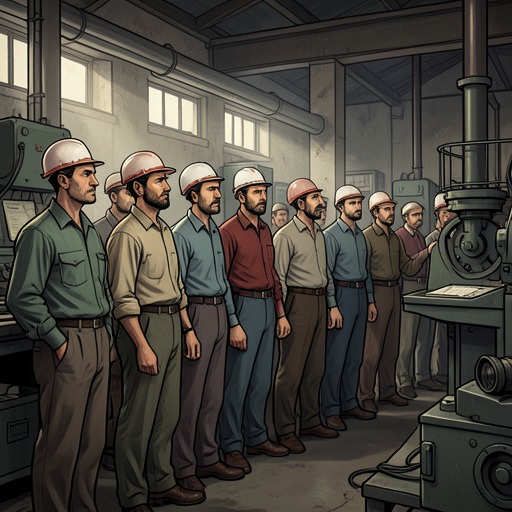
The march was organized by the Travancore-Cochin Marxist Labour Union. Its members’ comrades in Trivandrum planned to march to the Secretariat and present a Charter of People’s Demands to Comrade E. M. S. The specific demand described is limited but concrete: paddy workers, who worked eleven and a half hours daily, from seven in the morning until six-thirty in the evening, were seeking permission for a one-hour lunch break. The account compares the petitioners to an orchestra appealing to its conductor, an image that frames the procession as an organized appeal to political authority rather than an uncontrolled crowd.
The march is also part of a wider process of political mobilization. It arrives as a column of men with flags and banners, its hum growing as it approaches, then expands into thousands of people. That scale makes the railway crossing a point where ordinary traffic yields to the passage of organized workers. The demonstration’s practical demand and its sheer numbers are presented together: the long working day gives the protest its material cause, while the procession gives that cause a public form.
The crossing and the Ipe family
The march surges around the sky-blue Plymouth on a sky-blue December day. Within minutes, the road is filled with marchers; cars become islands in a river of people, and red flags fill the air as the crowd ducks beneath the level-crossing gate and sweeps over the railway tracks. These details locate the political event in a specific interruption of movement: the family’s vehicle is surrounded, and the crossing becomes a passage occupied by the march rather than a route controlled by private traffic.
The procession’s impact is registered bodily through Rahel’s pounding pulse. The scene moves from the approach of a distant column to the sudden presence of thousands, turning a political demonstration into an immediate encounter for those caught beside the road. The family does not direct the march or its demands; its members are witnesses to an event whose scale briefly makes their private space feel small and exposed.
Rahel’s recognition and Baby Kochamma’s flag
Amid the march, Rahel sees Velutha and identifies him as Vellya Paapen’s son and as her most beloved friend. The recognition connects the mass political scene to a personal relationship. The procession does not merely pass through the family’s landscape: it places Velutha in Rahel’s sight at a moment when public identities—worker, marcher, political comrade—meet her private knowledge of him.
Baby Kochamma’s encounter with the march produces a different kind of contact. A man described as knot-like gives her his red flag as a present, and she whispers the slogan "Inquilab Zindabad." The flag and words mark her participation in the scene, but the circumstances do not establish that she has embraced the movement’s aims. The moment instead shows how the march can draw even a reluctant onlooker into its visible signs and language.
Political spectacle and social limits
The march’s demand for a lunch break belongs to a politics of labor rights, yet the surrounding social order remains sharply unequal. Chacko calls himself a Marxist and invokes labor rights and trade-union law when speaking with women employed at the factory, but his conduct toward them retains the privileges of an employer. He summons them to his room under the pretext of lectures, flirts with them, insists that they address him as Comrade, and makes them sit with him for tea. The contrast makes the march’s language of solidarity more complicated: political vocabulary can challenge exploitation in public while leaving personal and workplace hierarchies intact.
Caste further limits what political and social belonging can mean. Velutha’s grandfather Kelan was among those who converted to Christianity under British rule in an effort to escape untouchability. The converts were nevertheless separated into their own churches, services, and clergy; after Independence, their formal classification as Christians also left them without certain government benefits available through caste-based provisions. This history informs the significance of Rahel seeing Velutha among the march’s public world: collective political action takes place within a society whose exclusions are not erased by formal religious or political identities.
The same inequalities govern the Ipe household. Baby Kochamma holds that a married daughter has no place in her parents’ home and that a divorced daughter has no place anywhere; her outrage deepens when the divorce follows a love marriage across communities. Ammu’s labor in the family factory does not give her a legal claim to it: Chacko registers the business as a partnership, calls Mammachi its sleeping partner, and refers to the enterprise as his when dealing with inspectors, although Ammu works there as much as he does. The family’s economic and gender arrangements thus stand beside the public procession as another form of social order, one not resolved by the appearance of red flags.
The scene’s larger significance lies in this juxtaposition rather than in any claim that the march transforms Ayemenem. It makes labor’s collective demand visible, gives Rahel a sudden sighting of Velutha, and momentarily places a public political emblem in Baby Kochamma’s hands. Yet the later account of Velutha’s treatment by the authorities reveals the limits of such visibility: a person’s political support matters to the police calculation, while caste and family respectability shape whose account can prevail. The march opens a public space for workers’ claims, but it does not by itself dismantle the structures that determine who is protected, heard, or excluded.